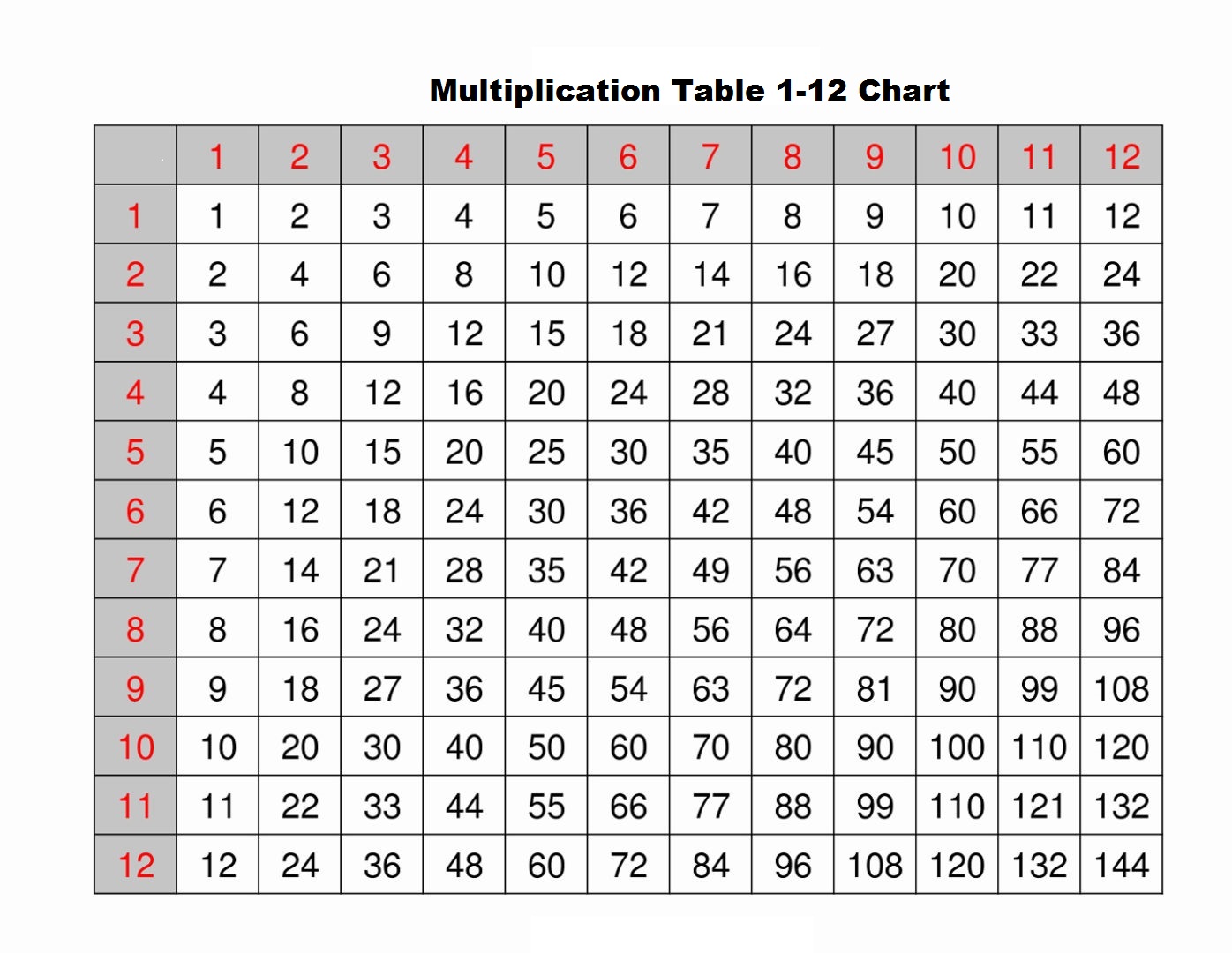

Mastering basic arithmetic is the cornerstone of all next numerical success, and the Multiplication Chart To 12 serves as one of the most lively tools in a student's educational arsenal. Whether you are a parent aid your minor with homework, a teacher looking for efficient schoolroom strategies, or an adult looking to sharpen your mental maths skills, understanding the construction and logic behind this grid is all-important. Times is more than just rote memorization; it is the gateway to understanding dimension, fractions, and complex algebra. By internalise the figure ground within a 12x12 grid, learner evolve a sentience of numerical fluency that allow them to solve job with speed and confidence.
Understanding the Structure of a Multiplication Chart To 12

The Multiplication Chart To 12 is a square grid that exhibit the ware of two number, typically range from 1 to 12. The numbers along the top row and the leftmost column service as the divisor, while the cells where they cross bear the merchandise. This visual representation is fantastically effective because it grant the brain to see the relationship between number spatially. Rather of viewing multiplication as isolated facts, the chart demonstrate it as a cohesive scheme of patterns and sequences.
When appear at the chart, you will note various key feature:
- The Identity Element: The initiative row and column (the 1s) simply repeat the sequence of number, prove that any bit multiplied by one rest itself.
- Symmetry: The chart is a mirror persona across the diagonal line of square numbers (1, 4, 9, 16 ... 144). This instance the Commutative Property of Multiplication (e.g., 3 x 4 is the same as 4 x 3).
- The 12x12 Boundary: While multiplication tables can go endlessly eminent, the 12x12 limit is a measure in instruction because it covers the most mutual calculations used in day-by-day living and set students for the imperial system of measurement (like inches in a foot).
The Full Multiplication Chart To 12
Below is a comprehensive Multiplication Chart To 12. You can use this table to quickly find production or to identify the practice we will discourse later in this guide.
| × | 1 | 2 | 3 | 4 | 5 | 6 | 7 | 8 | 9 | 10 | 11 | 12 |
|---|---|---|---|---|---|---|---|---|---|---|---|---|
| 1 | 1 | 2 | 3 | 4 | 5 | 6 | 7 | 8 | 9 | 10 | 11 | 12 |
| 2 | 2 | 4 | 6 | 8 | 10 | 12 | 14 | 16 | 18 | 20 | 22 | 24 |
| 3 | 3 | 6 | 9 | 12 | 15 | 18 | 21 | 24 | 27 | 30 | 33 | 36 |
| 4 | 4 | 8 | 12 | 16 | 20 | 24 | 28 | 32 | 36 | 40 | 44 | 48 |
| 5 | 5 | 10 | 15 | 20 | 25 | 30 | 35 | 40 | 45 | 50 | 55 | 60 |
| 6 | 6 | 12 | 18 | 24 | 30 | 36 | 42 | 48 | 54 | 60 | 66 | 72 |
| 7 | 7 | 14 | 21 | 28 | 35 | 42 | 49 | 56 | 63 | 70 | 77 | 84 |
| 8 | 8 | 16 | 24 | 32 | 40 | 48 | 56 | 64 | 72 | 80 | 88 | 96 |
| 9 | 9 | 18 | 27 | 36 | 45 | 54 | 63 | 72 | 81 | 90 | 99 | 108 |
| 10 | 10 | 20 | 30 | 40 | 50 | 60 | 70 | 80 | 90 | 100 | 110 | 120 |
| 11 | 11 | 22 | 33 | 44 | 55 | 66 | 77 | 88 | 99 | 110 | 121 | 132 |
| 12 | 12 | 24 | 36 | 48 | 60 | 72 | 84 | 96 | 108 | 120 | 132 | 144 |
How to Effectively Use the Multiplication Chart To 12
See the Multiplication Chart To 12 can find overwhelming at initiatory glimpse. However, when break down into logical steps, the task get much more manageable. Instead of trying to learn 144 case-by-case facts, focus on the following strategies to make your science progressively.
Footstep 1: Start with the Easy Wins
Begin with the tables for 1, 2, 5, and 10. These follow very simple rules:
- The 1s are just the numbers themselves.
- The 2s are just duplicate the bit (even numbers).
- The 10s are just the figure with a nix bring to the end.
- The 5s always end in 0 or 5 and follow a rhythmic pattern.
Step 2: Agnize the Commutative Belongings
As mentioned before, a × b = b × a. This is a game-changer for learner. If you know what 3 x 7 is (21), you automatically know what 7 x 3 is. By applying this logic, you efficaciously cut the number of facts you necessitate to con in one-half.
Step 3: Master the Square
Hear the "double-dyed squares" that run diagonally down the middle of the chart: 1, 4, 9, 16, 25, 36, 49, 64, 81, 100, 121, and 144. These act as mental anchor. If you cognize that 6 x 6 = 36, then account 6 x 7 is just 36 + 6.
💡 Tone: Consistent recitation for 10 minutes a day is more effective than one long report session once a week.
Advanced Tips and Tricks for Difficult Numbers

Once the basic figure are mastered, the "tough" numbers like 7, 8, 9, and 12 often cause the most stress. Here are specific hacker to undertake these sections of the Multiplication Chart To 12:
The Magic of 9s
There is a fascinating form in the 9s table. For any ware of 9 (up to 10), the sum of the digits always touch 9. for illustration:
- 9 x 2 = 18 (1 + 8 = 9)
- 9 x 5 = 45 (4 + 5 = 9)
- 9 x 9 = 81 (8 + 1 = 9)
The "Double-Double-Double" for 8s
If you notice the 8s difficult, remember that multiply by 8 is the same as doubling a routine three times. Example: 8 x 6. Duple 6 is 12, two-fold 12 is 24, doubled 24 is 48. This mental crosscut cut the demand for "difficult" memorization.
Breaking Down the 12s
To resolve anything in the 12s column of your Multiplication Chart To 12, separate the 12 into 10 and 2. Example: 12 x 7. (10 x 7) + (2 x 7) = 70 + 14 = 84. This technique, cognize as the Distributive Property, is a fundamental skill for high school algebra.
Why the Multiplication Chart To 12 Matters in Real Life
While we populate in an era of smartphones and reckoner, the utility of the Multiplication Chart To 12 remains eminent. Being able to perform mental calculations is about more than just getting the correct answer; it's about "number sentiency".
- Budgeting and Shopping: Cursorily calculating the price of three point that be $ 12 each allows for best financial decision-making on the fly.
- Cooking and Baking: If a recipe serves 4 but you want to function 12, you must understand the element of 3 to correct factor.
- Time Management: There are 60 minutes in an hour (12 x 5) and 24 hours in a day (12 x 2). Most of our time-keeping is based on the factors of 12.
- Professional Confidence: In encounter or patronage task (like woodwork or bathymetry), being capable to gauge dimension and cost without force out a phone demonstrates expertise and efficiency.
🧠 Note: Try to visualize the chart in your judgement when doing mental math; this spatial retentivity help with long-term retention.
Common Challenges and How to Overcome Them

Many learners get "math anxiety", peculiarly when put on the spot to answer multiplication question. This usually stem from a focus on speed rather than understanding. To overcome this, use the Multiplication Chart To 12 as a reference tool rather than a trial.
For children who struggle with memorization, games can be a outstanding choice. "Multiplication War" with play card or employ dice to generate figure to multiply turn a task into a challenge. Additionally, using a physical chart where the student colouring in the squares they have surmount can provide a visual sense of advance, further morale.
Another mutual vault is the 7s and 8s. These wrangle frequently have the fewest "leisurely" design. The good way to tackle these is through point pattern. Spend an full day centre simply on the 7s. Use them in sentence: "If I have 7 battalion of 7 poser, I have 49 spine". Contextualizing the figure make them stick best than nonfigurative repetition.
The Multiplication Chart To 12 is far more than a bare table; it is a foundational map of the relationships between figure. By exploring its patterns - from the simplicity of the 1s and 10s to the more complex 7s and 12s - learners build the cognitive tract necessary for advanced mathematics. Use scheme like the commutative property, breaking down larger numbers, and logical daily practice transforms multiplication from a dash task into a second-nature skill. Whether used for pedantic excellence or everyday virtual tasks, subdue this chart empowers person with the numerical fluency required to pilot a creation built on logic and mathematics. Keep practicing, look for the patterns, and shortly the entire 12x12 grid will be a natural part of your mental toolkit.
Related Footing:
- propagation chart printable
- generation chart 1 15
- multiplication chart to 20
- multiplication graph 1 50
- multiplication chart to 100
- multiplication graph 1 100