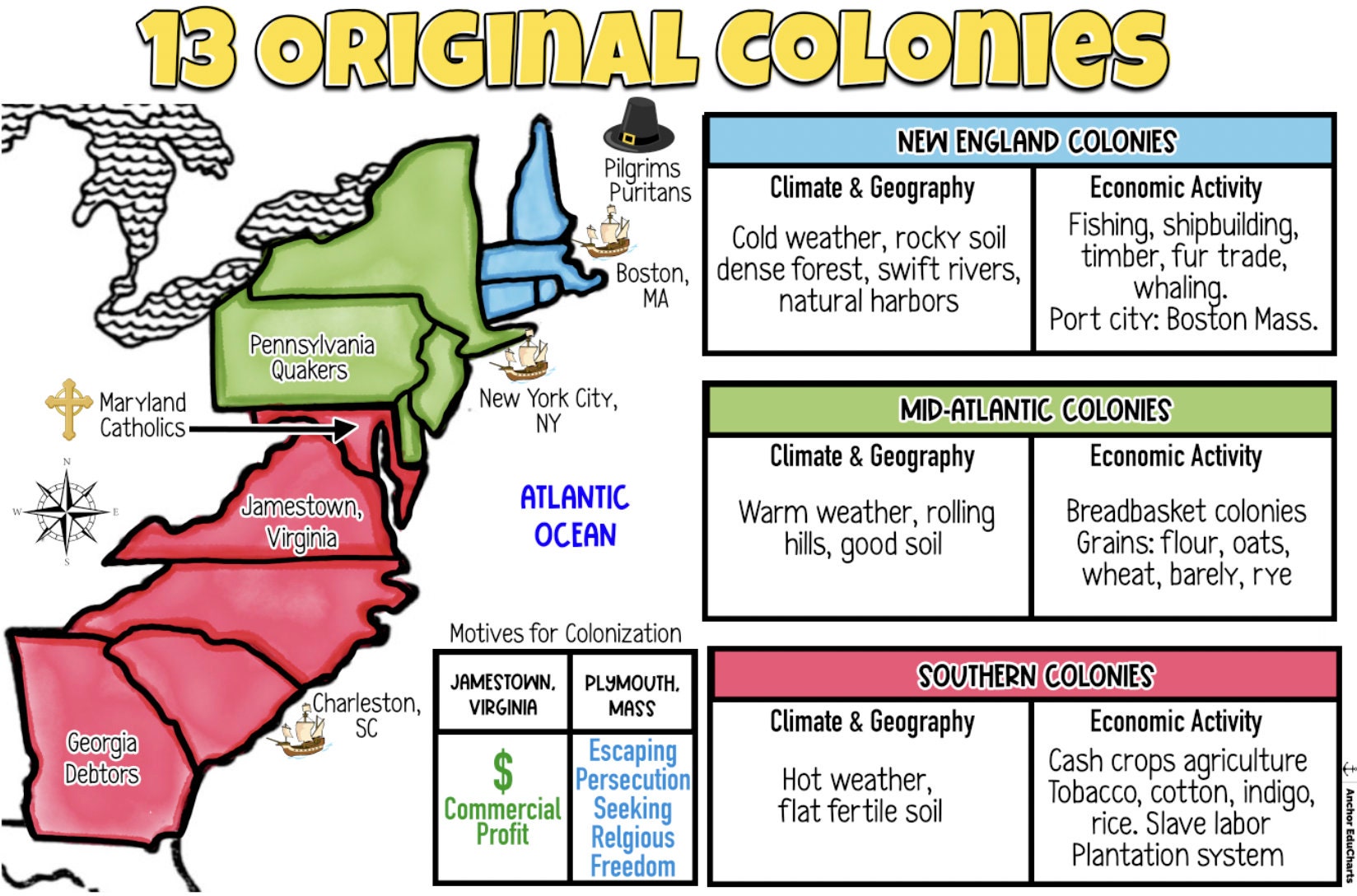

Understanding the foundational story of the United States requires a deep dive into the original British settlements that paved the way for a new nation. For students, historians, and pedagogue, a 13 Colonies Chart service as an essential optical and organisational tool to categorize the complex social, economical, and political construction of the early American landscape. These settlement were not a monolith; they were split into three distinguishable geographical regions - New England, Middle, and Southern - each with its own unequaled individuality and contribution to the eventual American Revolution. By analyse these settlement through a structured lens, we can amend understand how a radical of divers European immigrant and enslave Africans transformed a vast wild into a structured company.
The journey from the founding of Jamestown in 1607 to the signing of the Declaration of Independence in 1776 is a saga of survival, struggle, and invention. Each colony was established under different circumstances, range from the pursuit of spiritual freedom in the North to the pursuance for commercial-grade wealth in the South. Expend a elaborate 13 Colonies Chart aid clarify these motive, permit us to see the patterns of migration and industry that defined the colonial era. In this comprehensive guide, we will interrupt down each part, explore the specific characteristics of every colony, and provide a definitive citation for anyone seem to dominate early American history.
The Regional Divisions of the 13 Colonies

The 13 colony were geographically and culturally grouped into three specific part. These divisions were not merely lines on a map; they represented distinguishable mode of life dictate by the mood, the soil, and the descent of the settler who lived there.
- New England Colonies: Focused on maritime trade, fishing, and small-scale husbandry. These colonies were ofttimes founded for religious reason.
- Midway Colonies: Know as the "Breadbasket" settlement, they featured a diverse universe and a rich economy based on grain product and trade.
- Southern Colonies: Defined by a warm clime and fertile soil, these settlement relied heavily on large-scale plantation agriculture and labor-intensive harvest.
To grasp the compass of these deviation, a comprehensive 13 Settlement Chart is the good way to visualize the datum. Below, we have organized the colonies by their founding escort, the part they go to, and their chief economic drivers.
| Colony Name | Part | Twelvemonth Founded | Primary Economy | Reason for Founding |
|---|---|---|---|---|
| Virginia | Southern | 1607 | Baccy, Agriculture | Trade and Profit |
| Massachusetts | New England | 1620 / 1630 | Fishing, Shipbuilding | Spiritual Freedom (Puritans) |
| New Hampshire | New England | 1623 | Timber, Fishing | Evasion from MA restraint |
| Maryland | Southerly | 1633 | Tobacco, Farming | Religious Freedom (Catholics) |
| Connecticut | New England | 1636 | Farming, Trade | Political Exemption |
| Rhode Island | New England | 1636 | Transport, Livestock | Religious Tolerance |
| Delaware | Middle | 1638 | Trade, Agriculture | Trade and Agriculture |
| North Carolina | Southerly | 1653 | Baccy, Naval Stores | Trade and Profit |
| South Carolina | Southern | 1663 | Rice, Indigo | Trade and Profit |
| New Jersey | Middle | 1664 | Produce, Trade | Trade and Profit |
| New York | Middle | 1664 | Fur Trade, Shipping | Trade and Profit |
| Pennsylvania | Middle | 1682 | Grains, Iron | Religious Freedom (Quakers) |
| Georgia | Southerly | 1732 | Rice, Silk, Indigo | Debtor Relief / Buffer Zone |
📍 Note: The founding date may change slimly in different historical textbook reckon on whether they cite the initial charter or the first lasting settlement.
The New England Colonies: Faith and the Sea

The New England area dwell of Massachusetts, New Hampshire, Connecticut, and Rhode Island. This country was qualify by its rocky land and harsh winters, which create large-scale farming nearly impossible. Instead, the settlers become to the abundant resources of the Atlantic Ocean and the dense forests inland.
Religion played a central role in New England living. Most settler were Puritans or Pilgrims who essay to miss religious persecution in England. They established tight-knit community pore around the local encounter firm. Because of this focus on community and religion, New England became a hub for early teaching and literacy, as it was deemed indispensable for everyone to say the Bible.
Economic Pillars of New England:
- Shipbuilding: The immense availability of timber led to a thriving industry edifice ship for the British Empire.
- Sportfishing and Whaling: The cold waters of the North Atlantic render a steady supply of cod and whale oil.
- Subsistence Farming: Menage grew just plenty food to survive, focalise on corn and livestock.
The political structure in New England was rather forward-looking for its clip. The Mayflower Compact and the development of "Town Meetings" created an early sort of popular establishment that would influence the future United States regime.
The Middle Colonies: Diversity and Development

Often referred to as the "Mid-Atlantic" settlement, this part included New York, Pennsylvania, New Jersey, and Delaware. These colonies were the most ethnically and scrupulously diverse in British North America. Unlike the predominantly English New England, the Middle Colonies saw significant influxes of Germans, Dutch, Scots-Irish, and Swedes.
The geography was a perfect middle ground between the North and South. The mood was restrained, and the soil was rich. This permit for the monumental production of grains like wheat, barley, and rye, earning the area the nickname "The Breadbasket".
Key Characteristics of the Middle Part:
- Spiritual Tolerance: William Penn's "Holy Experiment" in Pennsylvania demonstrate a oasis for Trembler and others, further a acculturation of tolerance.
- Urban Centers: New York City and Philadelphia grew into major port metropolis and centers of mercantilism and acculturation.
- Fabrication: The area was rich in iron ore, leading to the maturation of early ironworks and paper mills.
When appear at a 13 Colonies Chart, the Middle Colonies stand out for their role as a bridge between the contrasting cultures of the North and the South. They were the melting pot of the colonial era, fostering an environment where different ideas could thrive.
The Southern Colonies: Plantations and Profit

The Southern Colonies - Maryland, Virginia, North Carolina, South Carolina, and Georgia - were specify by their long development season and fecund coastal plains. The motivation for institute these colony was mostly economic. Investors in the Virginia Company and other speculation hoped to notice au or other worthful resource to send rearwards to England.
While they didn't notice gold, they institute "green gold" in the form of Baccy. This labor-intensive harvest, followed by rice and indigo, mold the integral societal and economical construction of the South. This led to the growth of the plantation scheme, which swear heavily on apprenticed handmaid and, finally, the horrific system of enslaved African labor.
Social and Economic Component:
- Cash Crop: Husbandry focused on crop turn specifically for sale preferably than local ingestion.
- Class Construction: A small-scale group of wealthy planters held most the political power and wealth.
- Rural Living: Unlike the bustling township of the North, the South was mostly rural, with woodlet acting as self-sufficient communities.
Maryland was a slender outlier in this group, as it was primitively founded by Lord Baltimore as a resort for English Catholics, though it soon adopted the farming practices of its neighbor, Virginia.
💡 Line: Georgia, the last of the 13 settlement to be plant, serve a dual purpose as a place for debitor to commence over and a military buffer against Spanish Florida.
Key Figures in Colonial History
To full use a 13 Colonies Chart, it is helpful to cognize the names of the soul who shaped these territories. These leaders take different doctrine that dictated how each colony was regulate.
- John Smith: His leadership save the Jamestown colony from starvation in its early years.
- William Penn: The father of Pennsylvania, know for his reasonable treatment of Native Americans and publicity of spiritual freedom.
- Roger Williams: Bar from Massachusetts, he institute Rhode Island on the principle of breakup of church and province.
- James Oglethorpe: A visionary societal reformist who found Georgia for the "desirable poor".
- John Winthrop: A Puritan leader whose "City upon a Hill" preaching defined the religious mission of Massachusetts Bay.
The Path to the American Revolution
While the colonies were distinguishable in their origins and economy, several component began to unite them in the mid-18th hundred. The French and Amerind War (1754 - 1763) was a major turn point. Although the British won, the war left the crown with massive debts. To pay these debt, the British Parliament begin inflict taxis on the settlement, such as the Stamp Act and the Tea Act.
This "taxation without representation" activate a fire across all three regions. Despite their differences, the New England merchants, the Middle Colony traders, and the Southerly planter found a common foeman. The shared experience of compound life, document in any detailed 13 Colonies Chart, prove that while they were different, they were all becoming increasingly self-sufficient and resentful of remote British rule.
Mutual Tie That Bound the Settlement:
- Words and Law: Most colonists spoke English and work under the English Common Law scheme.
- The Great Wakening: A religious revivification that sail through the colonies, fostering a sensation of share American identity.
- Communication: Amend roads and postal service allowed for the exchange of revolutionary idea.
Summarizing the Colonial Foundations
The story of the thirteen colony is one of incredible diversity and speedy increase. From the rough shores of New Hampshire to the humid marshes of Georgia, the settler adapt to their surround to make a prosperous society. A 13 Colonies Chart ply more than just appointment and name; it provides a roadmap of how the United States evolve from a group of disjointed settlements into a unified strength capable of challenging the world's sterling superpower.
Realise the nuances of each region - New England's piety, the Middle Colonies' variety, and the South's agricultural might - is crucial for any student of account. These former centuries establish the ethnical and economical foundations that still shape American living today. Whether you are canvas for a history examination or simply curious about the rootage of the state, keeping these regional distinctions in judgement will volunteer a clearer picture of the complex tapis that is early American history. By direct this info into a integrated formatting, we can treasure the unequaled contribution each settlement made to the birthing of a new republic.
Related Terms:
- 13 settlement map with cities
- 13 original colonies by region
- 13 colonies government character
- 13 colony big to smallest
- 13 colonies by area
- list of all 13 settlement